Jaw Crusher
Jaw Crusher
Jaw crushers are among the primary machines in crushing lines, used for various mineral materials and large rocks in different sizes. Their size is determined by the feed opening at the top of the machine.
The fixed jaw plate is installed in a V-shaped configuration on a stationary surface, while the moving jaw applies crushing force to the material through the toggle mechanism, impacting and compressing the rock.
The space between the lower parts of the fixed and movable jaws determines the discharge opening of the jaw crusher, which defines the size of the output material. Rocks remain in the crushing chamber until they are reduced to a size that can pass through the lower opening and are then discharged.
In addition, due to the presence of an adjustment screw for the discharge opening, it is possible to easily adjust the outlet gap to achieve the desired output size as needed.
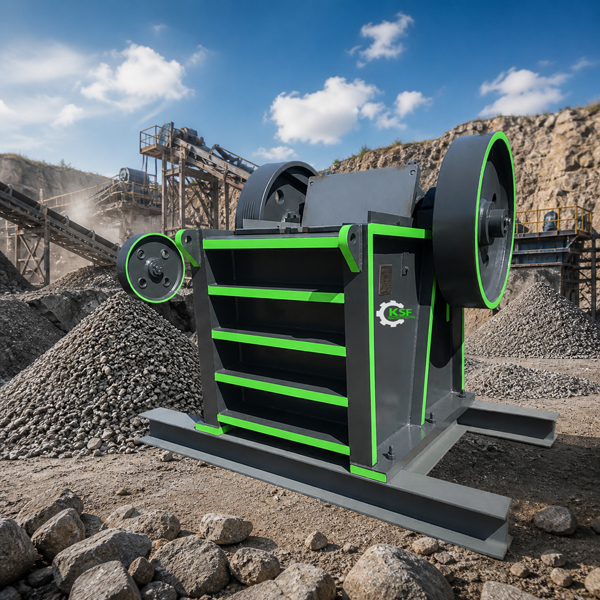
Features
Features of the Jaw Crusher
- Body made of high-thickness, high-strength steel plates.
- Stress-prone areas are reinforced with heavy-duty gussets made from the same base material.
- Precise design of the angle between the fixed and moving jaw plates to prevent material rebound upward.
- Fast and easy replacement of spare parts.
- High efficiency and reduced maintenance costs thanks to an integrated lubrication system.
| Exit Size (mm) | Maximum Entrance Size (mm) | Capacity (t/h) | Total Weight (t) | Electromotor Power (kW) | Model |
|---|---|---|---|---|---|
| 40 | 450 | 50-80 | 12 | 45 | SJ-45×65 |
| 50 | 550 | 50-80 | 13 | 55 | SJ-55×80 |
| 40 | 400 | 50-80 | 12 | 55 | SJ-40×90 |
| 100 | 600 | 110-113 | 17 | 75 | SJ-60×90 |
| 120 | 800 | 140-190 | 24 | 90 | SJ-80×100 |
| 150 | 900 | 180-250 | 32 | 90 | SJ-90×110 |
| 150 | 1000 | 150-350 | 48 | 132 | SJ-100×120 |