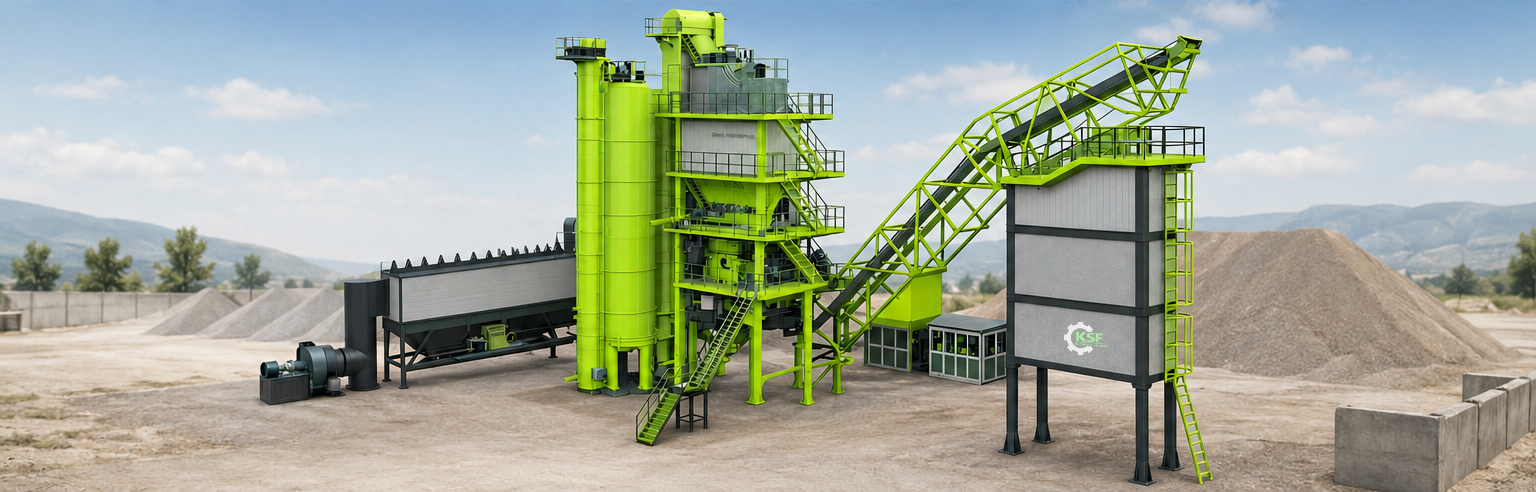
Asphalt Plants
Kasra Sangshekan Industrial Group’s asphalt plants are manufactured in both stationary and mobile configurations, with capacities of 60, 80, 120, and 160 tons, and all production units comply with international standards.
The operating process of these plants is based on standard aggregates with an initial moisture content of 3% and a production temperature of 160°C. The control system is available in fully automatic and semi-automatic modes.
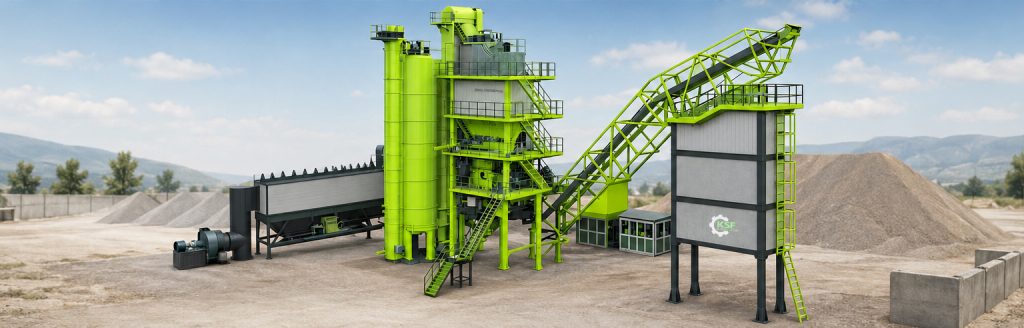
Components of Asphalt Plants
1. Plant tower (mixing tower)
2. Cold aggregate silo
3. Cold aggregate conveyor belt (feeding system)
4. Dryer
5. Burner (Turbojet)
6. Multicyclone dust collector
7. Exhaust fan
8. Baghouse filter (bag filter)
9. Flap gate
10. Thermal oil heater
11. Control panel
12. Control room
1
Asphalt Plant Tower (Mixing Tower)
In asphalt plants with capacities of 60 tons and above, the plant tower includes a vibrating screen, weighing system, mixer unit, hot asphalt storage silo, hot aggregate elevator, filler elevator, and supporting tower structure.
Screen:
The screen used in the asphalt plant tower is a four-deck vibrating screen made of 10 mm steel plate, equipped with a 7.5 kW electric motor and designed and manufactured in specific sizes. The body is covered with a protective casing to prevent dust emission and includes an overflow channel. The generated dust is transferred to a multicyclone system.
Aggregate, Bitumen, and Filler Weighing System:
The hot material weighing system features an automatic discharge gate and consists of four silo bins with four 1000 kg load cells. It is equipped with a digital indicator on the control panel and allows adjustment of tonnage and batch quantities.
Mixer:
The mixer has a capacity of 1.5 tons. Its outer body is made of steel plates, while the inner surfaces are lined with replaceable wear-resistant liners.
Mixer components and features include:
- 45 kW electric motor
- Dual rotating shafts
- 16 cast wear-resistant mixing arms (replaceable)
- Cleaning arms for internal maintenance
- Double-layer spray system with eight bitumen nozzles, equipped with a cover and dust collection duct connected to the cyclone system
- Two hydraulic cylinders for discharging mixed material into the asphalt storage silo
Asphalt Storage Silo:
The storage silo capacity varies depending on plant size and includes two discharge gates with pneumatic actuators.
Hot Aggregate Elevator:
This unit is located between the dryer and the screen. Its components include:
- Seamless, single-piece folded steel body
- Reinforced channels along length and width
- Specially designed bucket elevators
- Buckets chain system
- 15 kW motor and gearbox
Filler Elevator:
This unit is installed between the screw conveyor and filler silo. Its components include:
- Seamless folded steel body
- Reinforced structural channels
- Formed buckets
- Rod-based chain system
- 5.5 kW motor and gearbox
Plant Tower Structure:
The tower structure is made of folded steel plates, while the plant floors are constructed using industrial I-beams and channels.
Cold Aggregate Silo (4-bin type)
The capacity of this silo is 20 cubic meters and it is equipped with four compartments, with the possibility of increasing its volume. The silo body is made of 5 mm thick steel and includes four discharge gates, four feeder belts, a 2.2 kW electric motor, and a feeding conveyor belt with a width of 60 cm and a length of 11 meters. The conveyor speed can be easily adjusted using a 4 kW variable-speed motor and gearbox.
2
3
Cold Aggregate Conveyor (Feeding System)
This conveyor has a width of 60 cm and a length of 15 meters. Its function is to transport aggregates from the cold silo to the dryer.
Dryer
The asphalt plant dryer features a 10 mm thick steel body and is equipped with a 37 kW electric motor and gearbox. It consists of two heating sections: convection and radiation.
In the convection and radiation zones, 8 mm thick folded blades are used, along with 10 mm thick inlet and outlet boxes.
The main frame is constructed from UPN 24 channels and includes a gear ring system and steel rings, which are connected to the drum body using Z-shaped plates.
The dryer is equipped with two support rollers to prevent axial movement. The temperature of the aggregates can be monitored and controlled via a thermometer in the control room.
4
5
Turbojet Dryer Burner
The burner has a thermal capacity of 8 to 12 million kcal per hour, and its components include:
- A servomotor for adjusting the air damper and controlling fuel from the control room
- A 15 kW (3000 rpm) electric motor
- Dual-fuel system (gas and diesel)
- Multicyclone dust collector
This unit is responsible for collecting dust and filler material and consists of 42 cyclones. The collected filler is directed through a duct to the filler elevator.
Exhaust Fan
The exhaust air from the dryer and the automatic air pressure control are managed by the exhaust fan from the control room. The impeller of the asphalt plant exhaust fan is made of wear-resistant steel plate, and its diameter varies depending on the plant type. The electric motor power ranges from 35 to 65 kW, and in case of using a bag filter, it can be upgraded up to 90 kW.
6
7
Multicyclone Dust Collector
This unit is installed between the dryer and the exhaust fan, and its function is to collect filler (dust) generated in the dryer and transfer it to the filler elevator. It includes:
- Square-shaped body
- Cyclone dust collection units
- Cyclone blades
- Seamless folded steel support legs
- Channel steel frame (U-channel structure)
- Inlet and outlet ducts
- Equipped with solenoid valves or electric gear motors
Wet Filter / Bag Filter
Wet Scrubber
A wet scrubber is used to prevent dust, smoke, and combustion by-products from the burner from being released into the environment. Pollutants are directed by the exhaust fan from the top of the cyclone into the wet scrubber, where they are filtered and treated.
Bag Filter
A bag filter (baghouse filter) is used for more efficient and higher-level collection of dust and burner combustion by-products compared to a wet scrubber. This system generally consists of a clean air chamber, filtration chamber, filter bags, compressed air chamber, diaphragm valves, and a discharge system. The design of the bag filter is customized according to the capacity of the asphalt plant.
8
9
Bitumen Flux
The bitumen flux is a double-jacket tank with a capacity of 50,000 liters and is manufactured from 6 mm steel plate. Its outer covering is made of galvanized sheet, and its thermal insulation consists of fiberglass wool.
The bitumen flux is equipped with a bitumen pump and double-jacket inlet and outlet pipelines, driven by a 7.5 kW electric motor.
Thermal Oil Heater
The oil heater is used to provide heating and heat transfer for heating bitumen. In this system, thermal oil is heated to a temperature range of 160 to 200°C, and by pumping and circulating the hot oil through coils, the bitumen is heated to the required temperature and becomes ready for use.
10